Sunday, 20 October 2013

The Industrial Revolution

The wheel could have started as a toy and eventually its application created a new way to move goods and produce and further along the way it improved with the help of James Watt’s invention; the steam engine.  This invention marked the beginning of industrialisation because it revolutionised the meaning of industry and steel production.

Design style changes do not happen overnight but are the product of a complex mix of historical, political and social changes. In many cases styles co-exist for a time with the modern pushing the old out until forgotten through disuse.

Before the Industrial Revolution, goods were of low quality and produced by individual craftsmen from start to finish often at a high cost in labour and material. Eventually, when the idea of mass production took hold this brought the production costs down, production levels up and its retail price within reach of most of the population.

The time between 1914 and 1950 was a period of great upheaval, loss of life and world depression. However new technologies, sometimes developed during wartime, steadily improved and design went through different styles.

When talking about the Industrial Revolution, one cannot leave out the great Henry Ford! His revolutionary assembly line inventions for his automobiles created jobs and also reduced the price of autos down to a level that most consumers could afford. When Ford put in the assembly line method a Ford could be bought for $495.00. One could have it in “any colour you like as long as it is Black” which was his famous quote. During war times he adjusted his auto factories to military factories so that he could produce trucks for the army, scouting cars and even airplanes. During World War II his factories were producing Jeeps.

Therefore by the means of the assembly line more products could be completed more easily and more efficiently. For instance, Henry Ford managed to produce 15million cars in 20 years. What we need to understand is that by having mass production, products were standardized and therefore parts could be easily found. But apart from mechanics and cars, this was also happening to everyday and household designs. There started to be a loss of stylistic variety and designs were not made by artists or craftsmen. There was a drop in the quality of the product but on the other hand there were more affordable designs.

But to get into more detail about the quantity versus quality dilemma one has to talk about the Great Exhibition. But that is to be discussed in the next blog entry!


Late 19th Century London, Sep 2010. Making it magazine. [online] Available at: http://www.makingitmagazine.net/?p=1605 [Accessed on: 11th Oct 2013]

Jennifer Rosenberg. 20th Century History: Henry Ford. [online] Available at: http://history1900s.about.com/od/1920s/p/henryford.htm [Accessed on: 11th Oct 2013]


Ernesto Trejo & Cody Cortner. A Big Step Towards Fewer Steps – the assembly line and its importance.  [online] Available at: http://hfordassemblyl.weebly.com/the-assembly-line-and-its-importance.html  [Accessed on: 11th Oct 2013]

Thursday, 3 October 2013

Introduction to Design


What is Design? 


Design is what links creativity and innovations. It shapes ideas to become practical and attractive propositions for users or customers. It may also be described as creativity deployed to a specific end. Design is all around us, everything man-made has been designed, whether consciously or not. 
This is a simple definition from former Chairman, Sir George Cox in the Cox Review:


The design of things is the history of things. There is a difference between making things and a good way of making things. This is where design comes in! With regards to this point, Dame Vivienne Westwood pleaded to the people to: “Buy less. Choose well. Make it last. Quality, not quantity. Everybody’s buying far too many clothes. . . It doesn’t mean therefore you have to just buy anything cheap. Instead of buying six things, buy one thing that you really like. Don’t keep buying just for the sake of it. I just think people should invest in the world. Don’t invest in fashion, but invest in the world.”

The thing about design is that it changes due to time, technology and innovation. To design something you need to know its context, which means that you need to know your history, culture and surroundings prior designing anything! To better understand the difference between invention and design we can look at the example of the calculator. The first calculator machine was invented by Blaise Pascal in 1642, which looked nothing like the calculator we are accustomed to nowadays. But since then, due to the passing of time, its design has evolved to the present one, to which we pay more attention to ergonomics as well as function.


 What does design Mean?

Design can mean or imply various things. For instance how things look is the decorative design. But it also deals with how things work which is the functional design. Hence the well known statement of Form follows Function.

Fortunately in the 21st century we managed to have a balance in appearance and function thus functional things can also be pleasing to the eye!


Bibliography:

Mat Hunter, What design is and why it matters. [online] Available at: http://www.designcouncil.org.uk/about-design/What-design-is-and-why-it-matters/ [Accessed on 2nd October 2013]

John Dunne, September 2013, London Evening Standard. [online] Available at: http://www.standard.co.uk/news/london/buy-fewer-clothes-says-fashion-designer-vivienne-westwood-especially-if-youre-poor-8819634.html  [Accessed on 2nd October 2013]

Sunday, 13 January 2013

Development 5/5


Development 5/5
So I have finally finished my concept of the photo. 

From Les Demoiselles d'Avignon 

To

Les Demoiselles de Corleone


Development 4/5


Development 4/5

Now that the main idea is settled it is time to give life to the characters. Since in the painting there are five women, I decided to replace them with the five main female characters from the Godfather trilogy which are; Carmella known as Mama Corleone, Apollonia, Kay, Mary and Connie. Their clothing will be inspired from stills in various moments from the three films as well as the importance and power depicted.

Getting started!

Carmella/Mama Corleone
This character was chosen because even though she was never part of the criminal side of the Family she knew all about it. She is the typical Italian mother who served as a safe harbour to the family.  The dress I decided to use for her was the one she wore for Connie’s wedding in the beginning of the first film. 
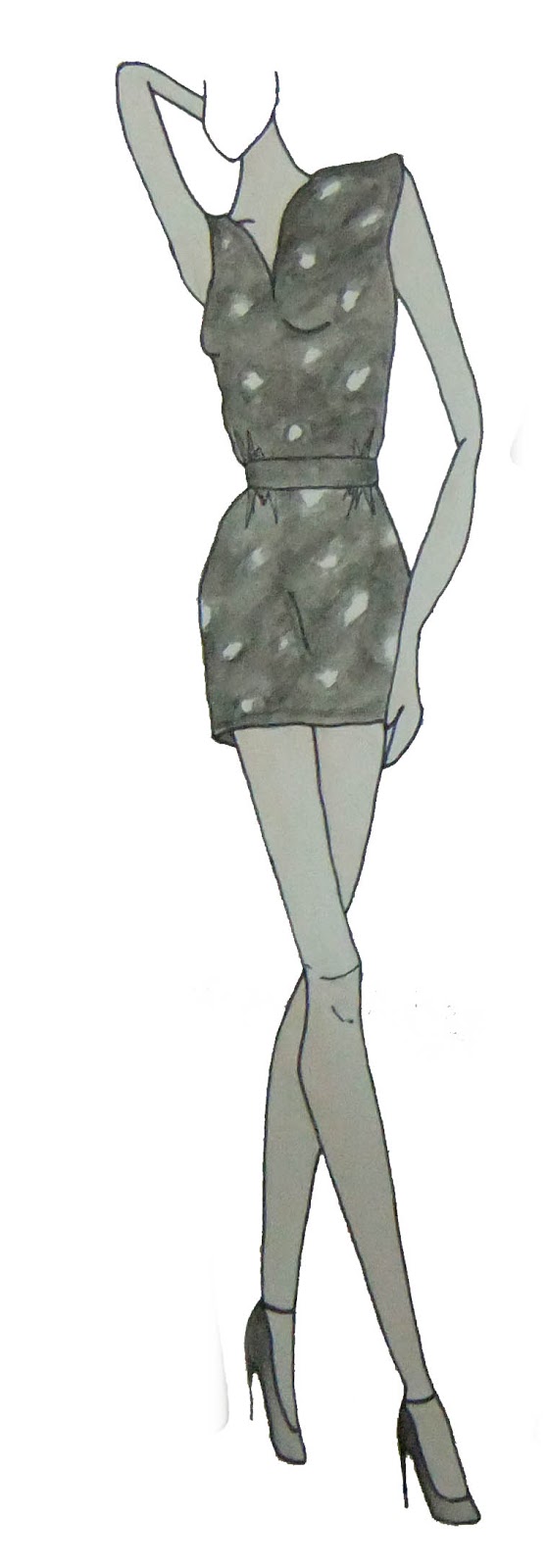
Apollonia Vitelli - Corleone
She was a young, simple and beautiful Sicilian girl who touched Michael’s heart like no other. I decided to use one of the dresses she wore when she and Michael were still courting but since it is black it resembles her fate; that of being assassinated instead of Michael.


I kept it simple with a v-neck and tied at the waist but short which apart from having a modern look it also resembles her short lived life.


Kay Adams Corleone
This character was always an outsider. She was an American and could never understand the traditional ways of the Italian family. She was also an independent woman who eventually ended up in destroying her marriage with Michael. 


In my opinion she did not have much style in clothes compared to the other Italians therefore I did some changes in her suit. Instead of having a blazer with tails and a below the knee skirt I dressed her in a trouser suit but keeping the same colours.


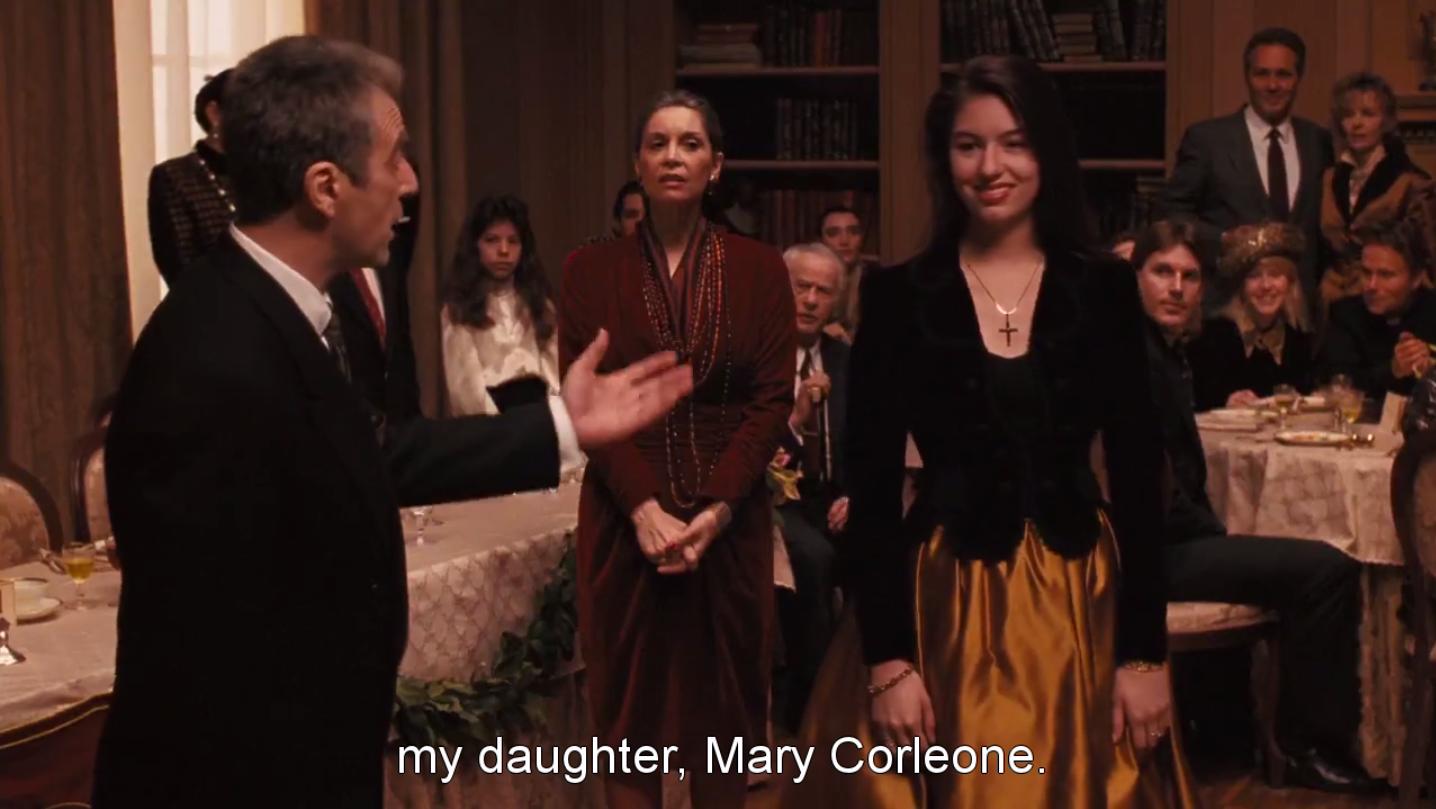
Mary Corleone
She was the clean side of Michael’s life. For her he had changed the way his business was run. But once she gets assassinated, instead of Michael like Appolonia, his sanity crumbles. For this character I decided to use her dress from the Opera scene and again I did some alterations to give it a more modern look as well to match the others. 


The main alteration in this dress is the colour. I decided to make it green showing life and make the dress more flowing and long to show elegance and flow.
Earlier in the film she is wearing a cross necklace and I decided to use it here as a symbol of her death.


All the figures are positioned in such order for a reason! Mama Corleone is the first, because she was there for Vito before the whole family started.  Apollonia comes next because she was Michael’s true love. After she is killed, he returned back to Kay from which marriage Mary was born. But the reason why Mary is positioned as the last person on the right is to provide the link with the next character; Connie. When Mary died, Connie took control and power of her family since Michael was not in a position to continue. In fact she was in charge of the actual transaction of power from Michael to Vincent.

Connie Corleone

To start with I decided to dress her in a suit with a feminine touch. I decided to take elements, such as the lace, from her Opera dress, since here it is visible her true power, importance and the fact that she was capable of murder to protect her family. 


Such power and importance is being shown in her pose. She is sitting down because every time that Michael is showing his authority he is always sitting down. This also links to the design of the chair, which is taken from a scene during Mama Corleone’s funeral on which Michael is sitting.


In Picasso’s painting there is a table which has fruits on it. Here I decided to use one of my previous concepts. This was also inspired from the film in the scene with the severed horse’s head in the film producer’s bed. Instead of any random fruit I decided to show oranges since they are almost always visible when murder is either being planned or about to happen. Oranges were also the favourite fruit of the old Don Corleone. I also placed a glass with whiskey since it is a drink often showed in the film as a consolation drink.


Development 3/5


Development 3/5

So I was thinking, since one of my main inspirations was Vanity Fair, a fashion magazine, I decided to use the designers’ way of drawing figures.


So now I could position my figures in any way I liked :) 

With regards to the film inspiration, I decided that the figures would not be naked in the finished drawing but instead show them wearing clothes inspired from the movie Godfather with a modern touch.

Development 2/5


Development 2/5

For my famous painting I decided to look back at my history notes and opted to use Picasso’s Les Demoiselles d’Avignon.  My first idea was to find photos of people in the pose that I wanted then use Photoshop to manipulate my images as I wanted. For the tables and chairs in the painting I would use designs we did in class.

 Picasso, P., 1907. Les Demoiselles d’Avignon Oil on Canvas (244 x 234 cm). [painting] Available at: http://en.wikipedia.org/wiki/File:Les_Demoiselles_d%27Avignon.jpg [Accessed 20th December 2012]

But that remained only an idea, since I didn’t find any people in the right poses and to alter them myself they would have been more distorted than Picasso’s! It would end looking more like a collage rather than something more concrete and finished. Another problem was that I still had no inspiration from a movie.

This is an example from one of my previous blog posts of how the picture would look like if I used Photoshop.


I need some more brainstorming for this concept to come out right!

Development 1/5


Development 1/5

I think that I have settled on the concept I want to develop! My final product is going to be a sketch to plan a photo even though the photo itself is not going to be taken. I decided to merge together two concepts; that of Vanity Fair taking a Still from an old movie and repropose it with today’s actors and that of taking a painting and replacing its characters with actors of the particular era in which it was recreated.

Merged with