Tuesday, 19 November 2013

Unity of the Arts

The De Stijl movement’s (originated in 1917) quest was for harmony and order through a universal language of form in which a particular work can be understood by all. This movement rejected all representation and was restricted to the use of straight lines, right angles and pure primary colours (red, blue and yellow) as well as non-colours (black and white).

De Stijl got its name from the Dutch magazine’s name edited by Theo Vann Doesburg in 1917 in which were published works by artists, one of which was Piet Mondrian. This movement arose at the same time as constructivism and rejected any imitation to nature. In fact Mondrian formulated his “theory of plasticism” in which he stated that art had to be completely abstract. Only vertical and horizontal lines can be used.

One of the most famous works of art for this period is by Piet Mondrian. He makes use of sever non-figurative designs which reflected the new industrial society. He only made use of vertical and horizontal lines bringing out rectangular forms. It is an asymmetrical composition with no representation what so ever. In fact if this work had to be rotated in any direction it would still make sense and its meaning would not be altered or lost. For instance;


Other interpretations are seen in clothing,


Album covers,


In 3D designs such as the Red and Blue Chair designed by Gerrit Rietveld in 1917,
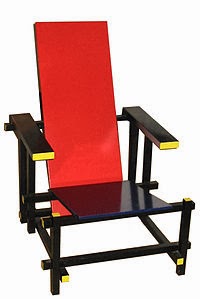

And later also in buildings such as the schröderhuis in Holland in 1924, which was an extension of what had started. The cube was the underlying form for architecture. While the surrounding houses are a block of bricks with dull colours, this was on the other hand was about bringing the outside to the inside. This was done by openness which let in more light.  Gerrit Rietveld also came up with the idea of constructing bigger rooms which can be transformed into smaller rooms by making use of partitions. He also made use of columns inside the house and walls made of glass, which was completely innovative at the time. In the interior we can also see experimental work such as the zigzag chair. There is lack of ornament, a sense of dynamism is created by the use of strong lines and the use of geometric formal vocabulary. 


Both found in the house.

All this was influential to the Modernist Movement. In the meantime in Italy, Filippo Tommaso Marinetti was founding the Futurist Movement. It was all about technology and the dynamic aspect of the modern life. It was founded to reject harmony and order as well as the museum-minded approach to the culture of the past. Its purpose was to embrace the modern technology namely speed, the machine and war.


Marinetti spread the idea that architecture challenges the idea that buildings should refer to history. Similarly, futurists following that type had to follow convention so experimented with new forms. For the Futurists, the new type was a way to emphasise the force of the expressive words. Important artists of this movement were Umberto Boccioni, Carlo Carra and Giacomo Balla.

Unique Forms of Continuity in Space, 1913 by Umberto Boccioni and François-Raoul Larche

These two pictures are an example to show the difference between, a Futurist statue to that of the Art Nouveau movement. It can be clearly seen that the excess of detail is removed completely, instead of the flowing, soft curves seen in Larche’s, in Umberto’s statue we get more angular, harsh lines. The delicate female form is replaced with a bulky almost grotesque figure while the realistic form is replaced by a more abstract figure.

We also have Carlo Carrà who is looking to the Cubist movement and the works of Picasso.


Woman on the Balcony, 1912 in comparison with Pablo Picasso’s Le Guitarist 1910.

We also have Giacomo Balla, in whose paintings he gives the impression of speed and fast movement due to the repetition of certain aspects or elements in his works.

Dynamism of a Dog on a Leash, 1912.

Charlotte Jirousek. 1995. Art, Design and Visual thinking: De Stijl. [online] Available at: http://char.txa.cornell.edu/art/decart/destijl/decstijl.htm [Accessed on 15th November 2013]

Lisa Tatcher. July 2012. Piet Mondrian – Line over Form.[online] Available at: http://lisathatcher.wordpress.com/2012/07/01/piet-mondrian-line-over-form/ [Accessed on 15th November 2013]

RGC. UN. 107.[online] Available at: http://itsfoolsgold.com/  [Accessed on 15th November 2013]

The White Stripes. June 2000. De Stijl. [online] Available at: http://www.last.fm/music/The+White+Stripes/De+Stijl  [Accessed on 15th November 2013]

Wickipedia. Red and Blue Chair. [online] Available at: http://en.wikipedia.org/wiki/De_Stijl  [Accessed on 15th November 2013]

Tomáš Petermann. July 2007. Utrecht (Haus Schröder/Rietveld) [online] Available at: http://www.panoramio.com/photo/3433076  [Accessed on 15th November 2013]

Carlos Zeballos. May 2013. GERRIT RIETVELD: SCHRÖDER HOUSE [online] Available at: http://architecturalmoleskine.blogspot.com/2013/05/gerrit-rietveld-schroder-house.html  [Accessed on 15th November 2013]


Vallecchi Casa editriche. Vallecchi un sognio lungo un secolo: Futurismo Manifesto. [online] Available at:  http://www.vallecchi.it/portali/37/bs/futurismomanifesto.html [Accessed on 15th November 2013]

Wikipedia. Picture: Unique Forms of Continuity in Space, 1913. [online] Available at: http://en.wikipedia.org/wiki/Umberto_Boccioni [Accessed on 15th November 2013]

UN. 2013. Macklowe Gallary: François-Raoul Larche [online] Available at: http://www.macklowegallery.com/education.asp/art+nouveau/Artist+Biographies/antiques/Decorative+Artists/education/Fran%26%23231%3Bois-Raoul+Larche+/id/153  [Accessed on 15th November 2013]

Joshsievgallery. UN. Gallery Project. [online] Available at: http://galleryproject.wiki.hhh.k12.ny.us/joshsievgallery  [Accessed on 15th November 2013]

Art Snapper Beta. May 2013. Giacomo Balla Adopts the Futurism Style. [online] Available at: http://artsnapper.com/giacomo-balla-adopts-the-futurism-style/#  [Accessed on 15th November 2013]

Paving the way to the Bauhaus Movement

One of the most influential and important architects of the 20th century was the famous Frank Lloyd Wright. He is the one who introduced a new understanding of architecture as well as design, in which he considered the building as an artistic whole. In which the interior had to compliment the exterior instead of treating them as two separate entities. He also combined simple and natural materials with modern building materials such as glass and concrete with wood and stone. He became the most important force of the Modern Movement by 1910. 

The house with which we are mostly familiar with is Falling Water built for Sir. Edgar J. Kaufmann in 1936. But for a figure as important as Wright it is bound to be more works, in fact he designed over 800 buildings like the Larkin Building 1904 in New York and the Oak Park House in Illinois.


Wright did not follow traditions. As can be seen in his Falling Water house, Wright made the fire place the centre point of the interior. Also he made use of asymmetrical layouts for the rooms. The use of functional straight lines gives the structure a low profile which creates interest. It is organically embedded in the surrounding nature. Wright was the first to apply reinforced-concrete cantilever slabs in this construction. 

Later, designers such as Walter Gropius, Mies Van Der Rohe and Peter Behrens will be influenced by the works of Frank Lloyd Wright.

When talking about Frank Lloyd Wright one cannot not mention the Modern movement in which he was a major force. The Modernists reacted against the over decorative elements of Art Nouveau and the decline in standards of craftsmanship. They linked art to the industry, encouraged bold geometric forms and asymmetric layouts. It was a new way of doing things. While in the US we have Frank Lloyd Wright, in Italy we have the Futurist movement and in Russia we have the Constructivist movement. 

In the meantime we have the Deutsche Werkbund which was an organisation formed in Germany to replace the Jugendstil. It was formed in 1907 by a group of artists, businessmen, architects and public figures. Their model was the English Arts and Crafts movement, in which they furthered the credo of William Morris. But they had an important difference, their aim was to standardise and rationalise forms for machines to improve production. They wanted to produce machine-made, mass produced goods of good quality similar to that of craftsmen and affordable to the working class.

Peter Behrens was one of the founders and here we are seeing one of his works The Kiss. There are still elements from the Art Nouveau but the whiplash curves are less pronounced. Also this work is done by wood cuts which are very reminiscent of Japanese prints and woodworks. Behrens is making use of block colours with very little detail. It has bold lines and is more flat.

Here is an example of a Japanese woodblock print to show comparison.


Peter Behrens pioneered and defined the field of modern industrial design with his product design for AEG. AEG was the first company to ever have a complete Corporate Identity.

This AEG kettle is in an octagonal shape which is very geometrical yet elegant, with very little detail whatsoever. It has enough curves in the handle to balance the whole thing out. It has a modern look to it due to the fact that Behrens paid more attention to functionality over the beauty aspect. Also it does not look very expansive making it possible for the working class to buy it as well.


The Little House Window design. 1998. Wright on the Web: Seventeen Buildings by Frank Lloyd Wright. [online] Available at: http://www.wrightontheweb.net/flw8.htm [Accessed on: 15th November 2013]

Petr Končal Design History Research: Perer Behrens. [online] Available at: http://designhistoryresearch.wordpress.com/category/peter-behrens/ [Accessed on: 15th November 2013]

Abdulaziz. March 2011. Art Nouveau: Peter Behrens and the corporate type design. [online] Available at: http://abdulazizfarache.blogspot.com/2011/03/art-nouveau-peter-behrens-and-corporate.html  [Accessed on: 15th November 2013]

The World of Tomorrow

To better understand where the idea of streamlining had started, one has to understand the concept of consumerism. That which states that expanding consumption of goods is advantageous to the economy. Thus designers have to come up with new ideas and designs in which they instigate the need for consumption in people. So by looking at events which lead up to such design, such as the Great Depression of 1929 the federal government wanted designers to increase consumerism in which they had to accommodate the consumers yet their presentation would be innovative for them to motivate them to buy the “new” product. Thus the process of “styling” initiated in which the Americans came up with the ideal styling of the period … that of the famous Streamlining.

The style of streamlining was being applied to any thing imaginable such as baby carriages, pencil sharpeners, orange juicers, cars, trains and much more.

Sterling Streamline Iron Designed                     Robert Heller, Airflow Table Fan Designed 
   c. 1930-40, Eric Brill Collection                                 c.1937, Eric Brill Collection      

Alessi Juicer.

     A 32 Ford looks faster than model T due to its dynamic shape.

The idealised water-drop form was able to minimize wind resistance which actually made any mode of transport faster not just in its looks. Streamlining is the result of aerodynamic research in aeroplane and automobile manufacturing since the First World War. Since the 1930s, streamlining has been used in the styling of various products and later in the 1950s was being used by all the industrialisation nations.

Even to this day we see modifications and improvements of the streamlining design in which designers are making use of it to enhance the idea of speed through visual communication. And even to this day it is mostly being used for transportation vehicles rather than in any ordinary objects, although sleek and dynamic designs appear to be more comfortable as well as pleasing to the eye.


From bullet trains in Japan … to the Maybach Exelero which is actually designed following the original 1950s design.

Farlex. The Online Dictionary: Consumerism. [online] Available at: http://www.thefreedictionary.com/consumerism [Accessed on 8th November 2013]

Hauffer T. 1998.design a concise history. London. Laurence King Publishing.

Wilsonart Contract. May 2011. Streamline Design. [online] Available at: http://www.wilsonartcontract.com/streamline-design/ [Accessed on 8th November 2013]

Elle Décor. 2013. To Alessi with Love. [online] Available at: http://www.elledecor.com/shopping/to-alessi-with-love#slide-4  [Accessed on 8th November 2013]

The H.A.M.B. September 2010. Streamlining 1930s. [online] Available at: http://www.jalopyjournal.com/forum/showthread.php?t=514957  [Accessed on 8th November 2013]

Coupe-desire. November 2013. Maybach Exelero. [online] Available at: http://www.coupe-desire.com/news/33/Goodyear_RFID  [Accessed on 8th November 2013]

Glamour's Golden Age

Art Deco is actually the age of decoration of the 1920s and 1930s, which got its name from a poster, like Art Nouveau, this time for the world fair in Paris. It is actually a simplified version of Art Nouveau, without the excessive whiplash curves. It is the time for glamour! It is characterised by the precise and boldly geometric shapes as well as bold colours. Art Deco was mostly used for architecture and household goods. Its products included both individually crafted luxury items and mass-produced objects. The main intention was to create a sleek and non-traditional elegance that symbolized wealth and sophistication, thus the creation of stream lining. 

An important exposition that characterises Art Deco was The Grand Salon of the Hôtel d'un Collectionneur by Émile-Jacques Ruhlmann, 1925. This was Ruhlmann’s stand at the Exposition Internationale des Arts Décoratifs et Industriels Modernes in Paris. This stand was luxurious ans fascinated the visitors with its elegance and exuberant style. Ruhlmann made use of mass produced materials such as Bakelite to replace the precious materials like ebony. The room still look luxurious but at a more affordable price for anyone to have in his home. Other materials which were discovered at the time and used were ivory, enamel, ebony and mother of pearl.

American Art Deco that followed the Paris exposition included all the decorative arts including furniture, flatware and interior design. With regards to the American Art Deco, what they did was to take “the best of European nationalistic styles and updated them, using new techniques and styles." - Barbara Capitman. The idea of adopting other cultures’ patterns continued also through this period. Artists were intrigued by the exotic discoveries and wanted to incorporate them in their creations. Such examples could be seen in:

Edgar Brandt, wrought iron standing lamp with glass bowl by Daum – 1925. This could have been an interpretation of the Indian snake charmers which would have been a novelty brought from the East back home to Europe and America.


During this time occurred other discoveries in foreign lands such as the discovery of Tutankhamen in 1922 which brought back the  fascination to Egyptian art by making use of the sun rays pattern as is shown in both these examples of: Parker Duofol desk set, ca. 1930 and Cochise County Courthouse doors, Bisbee, Arizona, 1931. Architect: Roy W. Place.


Another similarity is the famous Chrysler building to the Aztec, Inca and Mayan civilization by interpreting the ziggurats as well as the Egyptians in terms of the eagles.


Farlex. The Free Dictionary: Art Deco. [online] Available at: http://www.thefreedictionary.com/art+deco [Accessed on 1st November 2013]

Brynmawr. History of American Art Deco. [online] Available at: http://www.brynmawr.edu/cities/archx/05-600/proj/p2/npk/historydeco.htm [Accessed on 1st November 2013]

UN. Encyclopaedia Britannica: Art Deco. [online] Available at: http://www.britannica.com/EBchecked/topic/36505/Art-Deco [Accessed on 1st November 2013]

Katja Anderson, August 2013. Pinterest: The Grand Salon of the Hôtel d'un Collectionneur [online] Available at: http://www.pinterest.com/pin/77405687318558999/ [Accessed on 1st November 2013]

Seiji Yamauchi. 2009. Naturalistic spoon: Daum Freres. [online] Available at: http://naturalisticspoon.com/Daum_Freres.html [Accessed on 1st November 2013]

UN. 2012. Ancient civilisations: ziggurats.[online] Available at: http://www.crystalinks.com/ziggurat.html [Accessed on 1st November 2013]

Adam Underhill. Feb 2012. The Chrysler Building: New York’s Art-Deco Masterpiece.  [online] Available at: http://adamunderhill.wordpress.com/2012/02/26/the-chrysler-building-new-yorks-art-deco-masterpiece/ [Accessed on 1st November 2013]

Egyptian God Horus. [online] Available at: http://www.sculpturegallery.com/sculpture/egyptian_god_horus.html
[Accessed on 1st November 2013]

Fashion Fades, Only Style Remains the Same

Very recently I have watched Coco Chanel the movie for the very first time and was really amazed by all the things that Coco (originally Gabrielle) went through and shaped her to the iconic figure she still remains. Today everybody recognises the two famous interlocking ‘C’s as those of the logo for the great Chanel. But unfortunately not everyone knows the great sacrifice that lead to the legacy as we know it today. She was the one who freed the female figure from all the tightness of corsets to more flowing and comfortable clothing. 

Women were of the idea that “Beauty requires a bit of suffering” so that they would please as well as not insult the men. For instance having their ankles completely covered otherwise they would be indecent and look cheap. But on seeing this on her first work place Coco realised that that was not what women actually wanted. Male fashion designers used to be the ones who came up with female fashion garments, in fact, according to the movie, during a polo game Coco had an argument with Paul Poiret regarding this point in which he states to “Let Paul Poiret to determine what a woman wants to wear”, which in response Coco responds with “you mean what you want them to wear, but are you sure that’s the same thing”. This was all because she was going against the norm of that time by wearing a straw hat for something as elegant as a polo game. She was simply following her needs irrespective of what society said.


By also following her needs she was the one who introduced trousers to women which initially it was something only worn by men. The reason behind it was that she was being restrained by the skirt whilst in trousers she could do anything and were more practical.


In one particular scene Coco is showing her hat to Jacques Doucet, a French fashion designer known for his elegant dresses, in hopes that he would use one of her creations in a movie he was designing the clothes for. At one point the “actress” is in front of a mirror with both Doucet’s and Chanel’s woks and on the dress is visible a butterfly. It made me think of another Art Nouveau designer, Rene Lalique’s jewellery. Doucet was strongly influenced by the opulent era but he might have as well encountered works by Lalique in Paris.


Here is showing similarities of the designers’ works. Since it was the era of Art Nouveau, artists were being influenced by nature as well as portraying the female figure. It was not just in relation to ornaments but also enhancing the delicate female figure herself. Such element is brought out in Doucet’s dresses which reflect the elegance, softness and simplicity of a woman’s body, by making use of flimsy translucent materials in superimposing pastel colours.

Later on Chanel opened her first shop in Paris in 1913 with the help of one of the male admirers, who provided financial support and social connections over the course of her career. This lead to another shop opening in Deauville, which was a resort for the elite few. She also made dresses shorter which catered for everyone both rich and poor, the rich didn’t have maids to dress them and the poor needed to work.  There she had dedicated clients who made her sports wear a great success very quickly. This was due to the fact that the people who moved there did not bring maids with them thus the task of wearing corsets and elaborate dresses was much more difficult now and needed something more practical. To shock society even more her garments were made out of jersey, which was an unusual choice of fabric but due to her financial situation it was what she could afford. Before she started using it for her designs jersey was used for male underwear. But even after she had established herself well she continued to make use of jersey due to its qualities which draped well and suited her designs perfectly since they had to be simple and practical.


The shortened skirts, allowed women to leave their corsets behind and freed them for the practical activities made necessary by the war. Elements of these early designs became hallmarks of the Chanel look. Chanel took great pride as a woman in designing for other women, and by 1919, at the age of thirty-two, she enjoyed huge success, with clients around the world. Soon after, she relocated her couture house in Paris to 31 Rue Cambon, which remains the center of operations for the House of Chanel today.

To this day the look of Chanel is one that stands out. The elegance. The simplicity of it all. It is Chanel.


One of Chanel’s famous quotes is “to be irreplaceable one must always be different” and she sure was.

Nothing ever really disappears. After Boy died she designed a little black dress. She went on with her business. Everything was handmade and still is to this day so that everything is perfect. After the war her first collection was a total disaster and was not accepted by society. She was going to lose everything and another company was going to buy her out of her own business but she never gave up. She could lose even more money by breach of contract if she carried on with the second collection, but regardless she didn’t give up and carried on with everything she had in mind. She designed her second collection and brought it to the whole world to see. It was a sensation which lead to the great legacy we know today.

After Chanel’s death her assistants carried on her work with the same idea as she had, looking back at all the works she has created personally. Where her spirit and character will live on forever through her creations and continuity of her ideas and beliefs.


Jessa Krick, 2013. Heilbrunn Timeline of Art History: Gabrielle "Coco" Chanel (1883–1971) and the House of Chanel  [online] Available at: http://www.metmuseum.org/toah/hd/chnl/hd_chnl.htm  [Accessed on 31st October 2013]

Sainsbury centre. 2005. World Art Collection Exhibitions. [online] Available at: http://www.scva.ac.uk/collections/anderson/index.php?collection=29&collection_object=124 [Accessed on 31st October 2013]

The movie Coco Chanel portrayed by Shirley MacLaine

Design: a concise History by Thomas Hauffe